


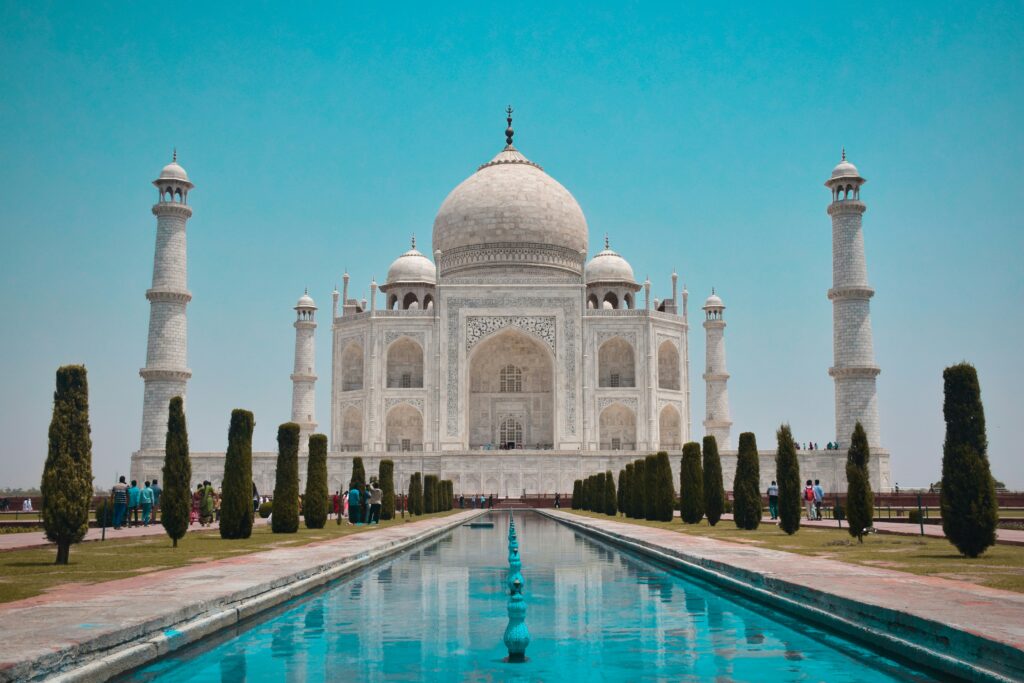
Majesty of the Taj Mahal
The Taj Mahal, often described as a “dream in marble,” stands on the banks of the Yamuna River in Agra, India, as one of the world’s most iconic symbols of love, craftsmanship, and architectural brilliance. For centuries, this monument has attracted travelers, scholars, artists, and romantics alike, each captivated by its serene beauty and the touching story behind its creation. More than just a mausoleum, the Taj Mahal is a masterpiece that blends history, art, culture, and emotion into a single grand structure.
A Monument Built for Love
The story of the Taj Mahal begins with the Mughal emperor Shah Jahan and his beloved wife, Mumtaz Mahal. Mumtaz, born Arjumand Banu Begum, was not only Shah Jahan’s wife but also his closest companion and advisor. Their relationship was marked by deep affection and respect, and she accompanied him even on military campaigns. Tragically, in 1631, Mumtaz Mahal died while giving birth to their fourteenth child. Shah Jahan was devastated by the loss and vowed to build a monument so magnificent that it would immortalize her memory.
Construction of the Taj Mahal began shortly after her death and continued for more than 20 years, employing over 20,000 artisans, laborers, craftsmen, calligraphers, and architects from across the Mughal Empire and beyond. The result was a mausoleum that not only honored Mumtaz Mahal’s memory but also demonstrated the zenith of Mughal architecture.
Architecture: A Harmonious Blend of Styles
The architectural beauty of the Taj Mahal lies in its perfect symmetry, intricate carvings, and the harmonious blending of different design traditions. Primarily influenced by Persian, Islamic, and Indian architectural styles, the monument presents a balanced and elegant appearance.
The central feature is the white marble mausoleum, crowned with a grand onion-shaped dome rising about 73 meters high. Each façade of the monument is adorned with delicately carved marble reliefs and Quranic verses inscribed in exquisite calligraphy. The four minarets—slender, graceful towers at each corner—are not only aesthetically pleasing but also structurally designed to tilt slightly outward, protecting the main mausoleum in case of collapse.
Inside, the cenotaphs of Shah Jahan and Mumtaz Mahal lie beneath the central dome, though their actual graves rest in a quiet chamber below. The interior is decorated with intricate pietra dura work—semi-precious stones inlaid into marble to form detailed floral and geometric patterns, giving the walls a jewel-like glow.
The Magic of White Marble
One of the most mesmerizing aspects of the Taj Mahal is its ability to change colors depending on the time of day and the angle of sunlight. At sunrise, it softly glows with pinkish hues; at midday, it shines bright white; and under the moonlight, it appears almost ethereal, bathed in a pale silver radiance. This visual transformation symbolizes the changing emotions associated with love—gentle, radiant, and timeless.
The white marble used in the construction was brought from Makrana in Rajasthan, while other materials such as turquoise, jade, sapphire, crystal, and lapis lazuli were sourced from locations as far away as Tibet, Persia, and China. The combination of these precious materials reflects the global connections of the Mughal Empire and the emperor’s desire to create something unparalleled.
Gardens of Paradise
Surrounding the Taj Mahal is a vast Charbagh, or four-part garden, inspired by Persian conceptions of paradise. Divided by walkways and water channels, the garden symbolizes order, harmony, and the spiritual vision of heaven as described in Islamic texts. The central reflecting pool perfectly mirrors the monument, creating one of the most iconic images in world photography. Walking through these gardens, one experiences a sense of peace and symmetry that enhances the emotional impact of the mausoleum itself.
A UNESCO World Heritage Site
In 1983, the Taj Mahal was designated a UNESCO World Heritage Site, recognized as “the jewel of Muslim art in India and one of the universally admired masterpieces of the world’s heritage.” Its significance extends far beyond India’s borders, symbolizing human creativity, devotion, and artistic excellence. UNESCO described it as an outstanding example of Mughal architecture, architecture that itself represents a fusion of numerous cultural influences.
Over the years, the Taj Mahal has become one of the most visited tourist attractions in the world. Millions of visitors walk through its gates annually to witness its beauty firsthand. Despite the heavy footfall, efforts by the Archaeological Survey of India, conservationists, and environmental organizations strive to preserve the monument from environmental threats such as pollution, weathering, and river erosion.
Symbolism and Cultural Impact
The Taj Mahal is more than a historic structure; it is a cultural icon. It has inspired poems, paintings, songs, films, and architectural imitations globally. For many, it symbolizes eternal love. For others, it represents the greatness of human craftsmanship and the power of artistic vision. It has become a part of India’s identity, featured on postcards, textbooks, and travel guides, representing the country on the world stage.
Its cultural influence is so deep that Rabindranath Tagore once described the Taj Mahal as “a teardrop on the cheek of time,” capturing the profound emotional significance it holds.
A Living Legacy
Although centuries have passed since its completion, the Taj Mahal continues to evoke admiration and wonder. Its marble walls have witnessed the rise and fall of empires, the passing of generations, and the evolution of the world around it. Yet it remains unchanged in its quiet beauty, standing as a testament to timeless love and artistic achievement.
Today, as visitors stand before the gleaming structure, they are reminded not only of Shah Jahan’s love for Mumtaz Mahal but also of the power of human creativity. The monument encourages reflection on themes that transcend time—love, loss, memory, and the desire to create something eternal.
Conclusion
The Taj Mahal is far more than a marvel of architecture; it is a story carved in stone. It embodies an emperor’s grief, an artist’s vision, and a civilization’s craftsmanship. Its beauty lies not only in its flawless design but also in the deep emotional narrative it carries. Whether viewed at dawn, day, or dusk, the Taj Mahal continues to inspire awe, reminding humanity of the enduring power of love and artistic genius. It stands as one of the greatest legacies of the Mughal era and remains, to this day, a symbol of beauty, harmony, and everlasting devotion.